|Stumbling with words| Recommendation N.16

The past few months have been uncomfortable and comfortable at once, a long stretch of pushing myself through academic writing. After so much time with academic reading, here are a few things from outside my research that I want to unload.
Things I Read
I recently joined a Southeast Asian reading group, where we read Kenneth R. Hall’s Maritime Trade and State Development in Early Southeast Asia, Thongchai Winichakul’s Siam Mapped, and Benedict Anderson’s The Spectre of Comparisons. As a quantitative researcher, I found the experience eye-opening. In my field, we talk a lot about QuantCrit and being critical of the categories we use. But reading beyond my discipline, I realized that this critical work had already been laid out decades ago by qualitative scholars. What I really need to do is keep reading beyond my field.
Maritime Trade and State Development in Early Southeast Asia — Kenneth R. Hall
Hall helped me think about early Southeast Asian states through their sea routes. The region sat on the maritime route between India and China, and rulers who controlled ports, rivers, and rice plains could turn that trade into power. He also helped me understand why Indic religious and political forms became so prominent in many Southeast Asian polities. It was not because India colonized the region. Local rulers chose Sanskrit, Hindu-Buddhist cults, and Indian ideas of kingship because these helped them stand above their rivals, and they blended these forms with local deities and ancestor worship. What I found interesting is that these polities ran on what is often called the mandala model. Authority radiated outward from a center through personal alliances rather than spreading evenly across a bounded territory. Religion was where power was reproduced. Rulers redistributed wealth through temples, festivals, and gifts, and temples became places where ritual authority met claims over land and labor. In the Sinic world, the examination system did that work. In Indic Southeast Asia, religion and ritual were how elites legitimized their rule.
Siam Mapped: A History of the Geo-Body of a Nation — Thongchai Winichakul
I really liked this book. The concept of the geo-body helped me think about how a national self becomes grounded in a recognizable territory. Thongchai shows how modern territorial boundaries became effective through Western geographical knowledge, colonial rivalry—particularly between Britain and France—and Siam’s own territorial ambitions.
It was a border without boundary line. Or one could say that it was a "thick line" with a broad horizontal extent. (p. 75)
The “thick line” made me reconsider boundary analysis in my own research, particularly regression discontinuity designs. If the historical frontier was a broad zone of overlapping authority, did institutional exposure really change sharply across the line I am using? Would comparing places within a buffer zone capture a meaningful difference, or would it place both sides within the same gradual transition?
The method of generalization means the reduction, selection, combination, distortion, approximation, or exaggeration of the very details of space to make them data for each particular map. (p. 53)
This quote is a reminder to question and critically check every act of generalization and categorization. Each one reduces something, and in doing so it can displace what is actually there and lead me to misjudge the real situation. It is a great reminder for me as a researcher.
The Spectre of Comparisons: Nationalism, Southeast Asia, and the World — Benedict Anderson
Anderson made me think about comparison itself. The title comes from Rizal’s novel: a young man returns to Manila from Europe, looks at the city’s botanical garden, and sees European gardens at the same time. Anderson calls this an “incurable doubled vision.” Once another place enters our perception, home no longer looks self-contained. What I took from this is that comparison always has a position. It matters who is comparing, from where, after what movement, and in which language. Reading history changes what I notice as a quantitative researcher, and spending time in another city changes what I notice about the place where I usually live. I was also interested in Anderson’s distinction between unbound and bound categories. Unbound categories, such as workers or nationalists, circulate through newspapers and performance, and people anywhere can imagine themselves into them. Bound categories come from censuses and elections. They are finite populations that can be counted and turned into majorities and minorities. The census does more than describe these groups, because it also gives people reasons to organize and make claims through them. In Anderson’s example, people classified as Chinese remain countable as Chinese whether they live in Jamaica, Hungary, or South Africa. The category stretches across the world, but its census-style boundary still decides who counts as a member. I also want to keep a line from Lord Acton that Anderson quotes: “Exile is the nursery of nationality.” Distance from home can make an attachment more self-conscious. This made me think that bound categories might intensify the we-self. The boundary Thongchai describes might then reappear as an imagined boundary within the diaspora.
Things I Watched
I also watched Hard Days (2023), 最後まで行く, directed by Michihito Fujii. I really liked how the plot kept unfolding in unexpected ways. A police officer tries to cover up a hit-and-run, and someone who witnessed it begins making demands; the situation keeps giving me another reason to reconsider what I think is happening. I found its approach to evil quite different from the usual crime plot. I was also interested in the bodily gruesomeness of it: the discomfort comes from what happens to the body, and from having to stay with that, rather than simply waiting for a jump scare. Overall, it felt refreshing. I enjoyed the uncertainty of where the story would go and how the next development would change my understanding of the people involved.
"— There was a lizard living in the desert. This desert was completely bare. All day long, he used his right and left legs alternately to stay on the sand. In this way, he kept his body still and alternated his legs until the sun goes down. He wasn't going when it would have been better to go somewhere else. He kept switching legs. He did this all his life. — What do you mean? — Do you want to get out of the desert?"
Things I Learnt
My interest in Asian immigration has recently led me toward South American settings. I have been thinking about Argentina and Peru side by side, partly because of conversations during the World Cup. Some friends from South America described Argentina as different from its neighbors and talked about how unpopular it could be in their football conversations. That stayed with me, and I wanted to understand more of the history behind the impression. Argentina's 1853 Constitution committed the federal government to encouraging European immigration, following Juan Bautista Alberdi's idea that "to govern is to populate." In practice, that project of nation-building favored white European settlers. It also pushed Indigenous and Afro-descendant Argentines to the margins of the national story.
During the summer, I also became curious about Peru's new president and her Japanese ancestry. I often encounter the idea of a "bamboo ceiling" in discussions of Asian representation, so this made me want to learn about another setting. Peru's Japanese immigrant history surprised me. The first organized arrival brought 790 contract laborers in 1899, and during World War II nearly 1,800 Japanese people from Peru were interned in the United States. Peru's Chinese immigrant history goes back even further. Between 1849 and 1874, roughly 80,000 to 100,000 Chinese contract laborers, almost all Cantonese men, were brought to work on sugar and cotton plantations and in guano mining, often under brutal conditions. Many stayed after their contracts ended, and their communities shaped chifa, the Chinese-Peruvian culinary tradition, and its best-known dish, arroz chaufa, a Peruvian take on fried rice. Over the past month, immigration histories in South America have intrigued me, and I think they are worth researching further. But, of course, only after I finish my PhD.
Things I’m Interested in Wearing
My interest in Japanese clothing, selvedge denim in particular, has led me back to American workwear and heritage clothing. I often hear the claim that Japanese makers take something American and make it better. Following those connections makes me want to learn more about cotton, weaving, and how clothes designed for work became things people wear and collect for very different reasons.
I have also been looking for American brands that still hold on to a quality, heirloom mindset, and Filson is one name I want to look into. I was interested to learn that it began in Seattle in 1897, outfitting prospectors heading north to the Klondike Gold Rush. The connection between clothing and its intended use appeals to me: weather, terrain, and physical work gave the fabric and design particular jobs to do. Clothes like these were built to last and to be passed down. That makes me want to look for clothes made with the same intention, and to build my wardrobe with that intentionality and an eye toward sustainability. I will come back with more notes on this.
Things I Noticed
Anderson’s doubled vision gives me a way to describe what happened while I was wandering around Ann Arbor: I started noticing Madison from afar. Both campuses use rocks in their landscapes, and I began paying attention to them in each place. In Ann Arbor, I noticed a rock surrounded by flowers opposite Ross School of Business and different kinds of stone in front of North University Building.

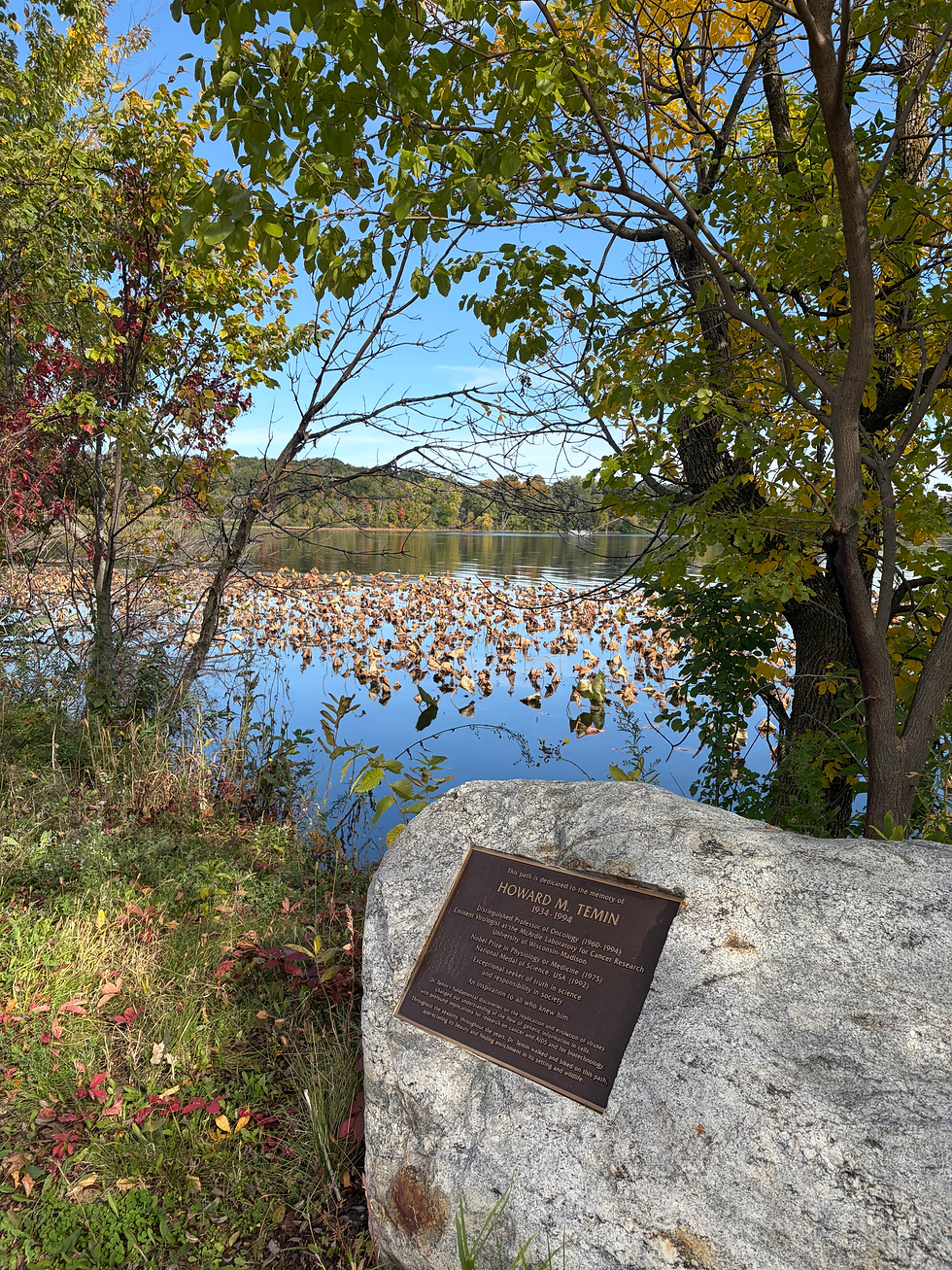
When I came back to Madison, I started looking at the rocks around campus. I searched for the stories behind their plaques. One small plaque honors the Sauk leader Black Hawk. It led me to a longer story. The campus sits on Teejop, the ancestral land of the Ho-Chunk Nation. In 1832, the Ho-Chunk were pressured to give up this land in a treaty. Another plaque honors Howard M. Temin. He shared the 1975 Nobel Prize in Physiology or Medicine for discovering reverse transcriptase. He used to bike to work along Lake Mendota. The Lakeshore Path there now carries his name. Checking the rocks became a fun way to learn the university's history.

The squirrels I noticed in Ann Arbor were rusty orange, unlike the ones I had become used to seeing in Madison. They looked different from the ones I was used to in Madison. They are very lively and friendly with people, sometimes too friendly. I also noticed shoes hanging from wires and found myself wondering about their meaning. Some people say they mark gang boundaries. But I do not want to assume that about any one pair. In a college town, they might mark a graduation or just be a prank.
This period reminded me of something I want to practice as a comparative researcher: moving beyond a familiar setting, then returning to look within it more carefully. Another place can make differences visible, but it can also show me what I had stopped noticing at home. I am interested in how that works across cities and across disciplines. For now, writing these observations down gives me somewhere to begin, and somewhere to return when I know a little more.
Till next time.
![[American City Chronicles] Stumbling in arts and words](https://static.wixstatic.com/media/354a00_dc35c9643ae94978919b4761c9597139~mv2.jpg/v1/fill/w_980,h_655,al_c,q_85,usm_0.66_1.00_0.01,enc_avif,quality_auto/354a00_dc35c9643ae94978919b4761c9597139~mv2.jpg)
Comments